The burndown
~5 openOne line, one date, zero confidence attached. Cut five and it says you're done.
Your burndown gives you a date with no odds attached. This free Claude skill reads one Favro board, replays your team's real days 10,000 times with a Monte Carlo forecast, and hands back the odds of hitting your date, a burn-up with the likely range, and the dates to plan on. Ask what-if questions before you touch a card. It posts the forecast to your milestone card only when you say yes.
From Jon Leslie, Favro's former SVP, Product & Solutions, and a Favro Solutions Partner.
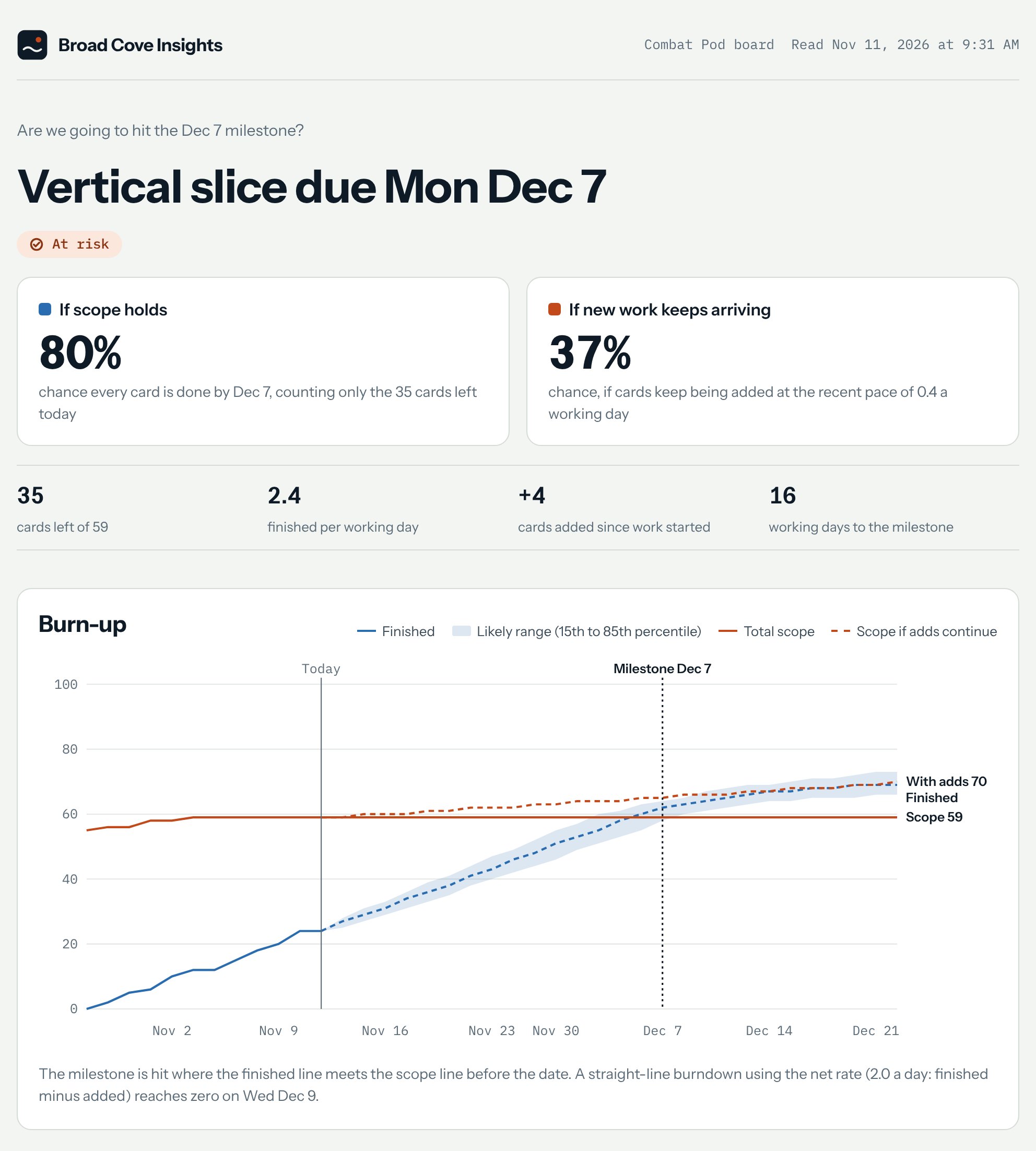
“Are we going to hit our Dec 7 milestone on the Combat Pod board?”
What if we cut cards? With new work arriving:
On the demo board, Favro's burndown projects about five cards still open on December 7. The obvious move is to cut five. The forecast tested that before anyone touched the board.
One line, one date, zero confidence attached. Cut five and it says you're done.
With new work arriving at the current pace. One time in three, the milestone still misses.
With new work still arriving. Over 99% if scope holds. A date you can commit to.
A burndown assumes every day ahead is an average day. This team's real days ranged from adding a card to finishing four. A Monte Carlo forecast, first developed at Los Alamos in the 1940s and used today for weather forecasting, plays those real days forward 10,000 times and counts how many futures land on time.
/favro-milestone-forecast
Name a board and a date. The skill reads every card through Favro's MCP connector, works out when each one finished, and simulates the remaining work from your team's real days. It counts cards, so nobody has to estimate anything first.
The chance every card is done by your date, once if scope holds and once if new work keeps arriving at its recent pace. The gap between the two numbers is what scope changes are costing you.
Finished work and total scope as two separate lines, with the likely range shaded around the forecast. You hit the milestone where the lines meet before the date, and a scope conversation never gets mistaken for a velocity one.
The 50%, 85% and 95% finish dates for both scenarios. Commit to the 85% date. The 50% date is a coin flip.
Blocked cards, a short history, holidays before the date, and how much of the remaining work hasn't started. Each one is spelled out, so you know how far to trust the number.
No story points, no estimates and no new fields. Size differences are already in the history: a day that closed one big card counts as 1, a day of small fixes counts as 3. A store manager staffs checkout by counting customers per hour, without counting the items in each cart.
It reads your board. Every card and the day it finished, through Favro's official MCP server.
It runs a Monte Carlo forecast. 10,000 possible futures, each built from real days of your team's finishes and new cards, once with scope holding and once with new work arriving.
It hands back one page, then asks. The odds, the burn-up and the dates. Say yes and it posts the summary and burn-up to your milestone card. Run it weekly and the card becomes the milestone's forecast history.
Any Claude plan that lets you add skills and connectors. The setup steps come with the files.
Connect Favro to Claude through Favro's official MCP server, using your own Favro account.
About two weeks of finished cards gives a steady forecast. It works with your columns as they are and tells you when the history is too short. Split any card that's obviously bigger than the rest first.
Each team's burndown shows its own date, and none of them shows the chance that all of them hit it. If four teams are each 90% likely to make the date, the milestone is only about 66% likely, because every one of them has to land.
I'm building that next: a secure, hosted agent that forecasts one milestone across every team's board and keeps the number current.
Book a workflow callEnter your email and you'll get the download link right away, with step-by-step setup for Claude and Favro.